Shopping Cart
There are no more items in your cart
The brain doesn't work like a computer, but like music
For decades, the brain has been compared to a computer: circuits, calculations, data processing. Recent research, published in a major neuroscience journal, overturns this image. The brain doesn't calculate like a machine: it resonates like music. And this discovery changes a great deal for anyone who wants to age well.
By Alain Ledroit — Laboratoire Géomer
The big revelation: your brain resonates, it doesn't calculate
In 2025, an international team gathered around Edward Large (University of Connecticut) and Caroline Palmer (McGill University) published a foundational synthesis in Nature Reviews Neuroscience: the theory of neural resonance ("Musical neurodynamics"). Its central idea is as beautiful as it is surprising.
When we listen to music, our brain doesn't just "decode" sounds. Its own oscillations — its internal electrical waves — physically resonate with rhythm, melody and harmony. The brain doesn't just understand music: it becomes music. This resonance even travels from the ear down to the spinal cord, which explains why a good song makes us want to move: the whole body joins the dance.
In other words: the brain is less a processor than a living orchestra. A German study (University of Mainz, 2025) points the same way: the highest-performing minds are not those whose waves are "permanently synchronized," but those able to flexibly adjust their rhythm, like an orchestra following a skilled conductor.
Synchronizing, laying down patterns, improvising
Following the musical metaphor (an illustrative image), a healthy brain does three things at once:
- It synchronizes — its regions align to a shared tempo to work together.
- It lays down patterns — stable musical phrases, like a recurring chorus.
- It improvises in rhythm — it adapts, varies, responds to the unexpected without losing the beat.
This rhythmic flexibility may well be one of the true signatures of a brain that works well — and that lasts.
When the inner music goes out of tune
This framework sheds new light on several imbalances observed in research:
- Depression appears as a loss of harmony: the orchestra plays, but without overall coherence, as if out of tune.
- Parkinson's disease shows up as a rhythm that becomes rigid: certain brain waves lock into an overly regular cadence, and movement stalls.
- Neurodegenerative diseases resemble a loss of diversity: the richness of variation dwindles, improvisation fades, the score simplifies.
These parallels describe what neuroscience research highlights; they are neither a diagnosis nor a promise of treatment.
Retuning the instrument: the power of rhythm
The most exciting consequence of this theory is that it opens the door to rhythmic approaches. The authors themselves highlight their potential in rehabilitation, particularly after a stroke or in supporting Parkinson's disease: rhythm, music and cadence can help the brain reorganize and regain flexibility.
Music then becomes a surprisingly powerful tool for maintaining the brain: having it listen to pieces rich in rhythmic and tonal variation invites it to improvise, to retune itself, to maintain its plasticity. A brain allowed to "play" remains a living brain.
Aging well: maintaining a musical brain
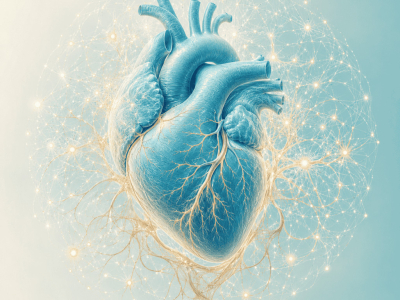
This is why this discovery directly relates to aging well. If brain health depends on its ability to stay "musical" — flexible, varied, in tune — then maintaining that musicality becomes a matter of longevity. This comes through active listening, movement, novelty… and also through the quality of the terrain on which this music is played. And this musicality doesn't only play out in the head: our heart also has its own network of neurons.
Discover "the heart, that little brain"
Where does silicon fit in? The terrain of music
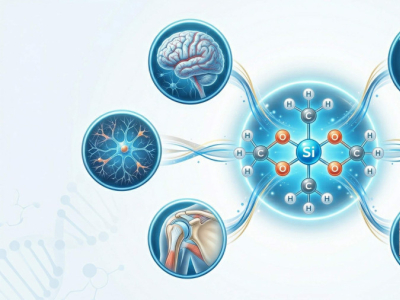
Let's return to the orchestra image (an illustrative image): for a symphony to sound right, you need good musicians… but also a healthy concert hall. This is precisely where organic silicon comes in — not as a "conductor," but as a guardian of the terrain.
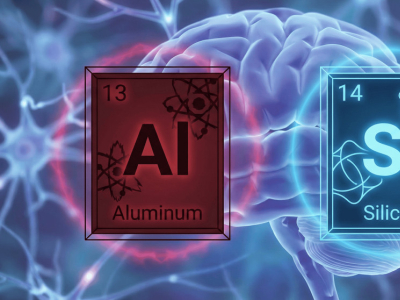
Silicon is known for its role in tissue quality and, above all, for its ability to act on aluminum, a metal recognized as a disruptor. A landmark clinical study (Davenward et al., Journal of Alzheimer's Disease, 2013) showed that drinking silicon-rich water for 12 weeks facilitated the elimination of aluminum through urine, without affecting essential metals such as iron and copper — with, in some participants, encouraging cognitive observations.
In plain terms: silicon doesn't "play" the music in place of your brain. But by helping to preserve the terrain, it helps maintain the conditions in which the inner music can play well. To learn more: the complete guide to organic silicon and silicon, the brain and aluminum.
Laboratoire Géomer is today the only lab to guarantee 1,200 mg/L of stable silicon within a complete holistic range inspired by traditional Chinese medicine.
Sébastien Ledentu's gesture: the razor as a bow
Our partner Sébastien Ledentu, an energetic hairdresser in Brussels, has made this idea of a body entering resonance his own in his Original Energetic Cut. With his 7 cm full-blade razor, he doesn't just cut hair: he works it the way a musician draws a bow across a violin's strings.
The image (an illustrative metaphor) says it all: a slow, rhythmic, almost musical gesture, experienced by many as a genuine ritual of relaxation and reconnection with oneself. Also discover our approach to energetic care and meridians.
4 habits to maintain a musical brain
- Vary the rhythms — favor music rich in tempo and tone changes, inviting the brain to improvise.
- Move to music — walking, dancing, moving: the whole body enters resonance.
- Seek novelty — learning a language, an instrument, or taking an unfamiliar route nourishes plasticity.
- Take care of the terrain — limit exposure to aluminum and support your intake of organic silicon.
In summary
Your brain is not a computer: it is living music, made of synchronization, patterns and improvisation. Keeping it flexible and varied is one of the finest gestures for aging well. And for this music to play on healthy ground, organic silicon has its full place in a global lifestyle approach.
Frequently asked questions
Does the brain really work like music?
This is the image proposed by the theory of neural resonance (Nature Reviews Neuroscience, 2025): the brain's electrical oscillations resonate with rhythm and harmony, rather than "calculating" like a computer. The musical metaphor translates a real synchronization phenomenon, without being a literal description of anatomy.
Can music change the brain?
Rhythmic and musical approaches are currently being explored in rehabilitation, particularly after a stroke or in supporting Parkinson's disease, to help the brain regain flexibility. Listening to music rich in variation is thought to help maintain brain plasticity.
Does silicon have an effect on the brain?
Silicon's documented role mainly concerns aluminum: it helps reduce its burden in the body (Davenward et al., 2013). It therefore acts on the terrain, without "playing" the music in place of the neurons. It thus allows for music of much better quality.
From what age should you maintain your "musical brain"?
At any age. Our silicon reserves gradually decline over the years, and plasticity is maintained throughout life: through listening, movement, novelty and the quality of the terrain.
— Alain Ledroit, CEO of Laboratoire Géomer, Usui Reiki Master, creator of the ARK Quantique Process®
And how is your inner music doing?
Take stock of your terrain and your needs with our free personalized assessment.
Get my assessmentScientific sources:
• Harding E.E., Kim J.C., Demos A.P. et al. Musical neurodynamics. Nature Reviews Neuroscience, 2025;26(5):293. DOI: 10.1038/s41583-025-00915-4
• Davenward S., Bentham P., Wright J. et al. Silicon-rich mineral water as a non-invasive test of the 'aluminum hypothesis' in Alzheimer's disease. J Alzheimers Dis. 2013;33(2):423-30. PMID: 22976072
This article is for informational and wellness purposes. It does not replace medical advice and does not constitute a diagnosis or a promise of treatment. Géomer cosmetics and dietary supplements are not a substitute for medical care.