Shopping Cart
There are no more items in your cart
Drinking collagen to look younger: the mistake almost everyone makes
-
Categories :
, Our skin beauty tips
.png)
Alain Ledroit
CEO Laboratoire Géomer · Usui Reiki Master
creator of the ARK Quantique Process®
CEO Laboratoire Géomer · Usui Reiki Master
creator of the ARK Quantique Process®
One evening, on a hugely popular YouTube channel, an entrepreneur explains how he became a millionaire selling drinkable collagen. His argument? "From the age of 25, you lose your collagen, and therefore your youth. Drink some, and you'll get it back." It's simple, it's appealing… and it's largely a misunderstanding of how your own body works. Here's what science actually says — and why the real lever isn't in the glass of collagen.
On one point, the seller is right
Yes, your collagen stores decline with age. Collagen is the body's most abundant structural protein: it's the scaffolding of the skin, the cushion that keeps it firm and bouncy. From the late twenties onward, its production slows and its breakdown accelerates. The skin thins, loses its bounce, the first fine lines appear. So far, the observation is correct.
The problem begins with the proposed solution: "you're missing it, so swallow some." It's common-sense logic… but the body doesn't work like a tank you top up.
What actually happens when you drink collagen
Collagen is a protein. And like any swallowed protein, it doesn't pass as-is into your skin. Starting in the stomach, then in the intestine, it's cut into very small pieces: amino acids and short fragments called peptides. Picture a beautiful wooden frame delivered to your door… but disassembled plank by plank before it enters the house. The collagen you drink never arrives "whole" at the level of the face.
Should we conclude it's entirely useless? Let's be honest: no, and we won't make the mistake of claiming that. Some of these small fragments — particular di- and tripeptides such as Pro-Hyp or Gly-Pro-Hyp — resist digestion, pass into the blood, and reach the dermis. There, they don't act as raw material, but as a signal: a kind of note telling skin cells "get back to work." Several summaries of clinical studies also observe a modest improvement in hydration and elasticity.
Gelatin and bone broth: our grandmothers' collagen, for a few cents
Here's an uncomfortable truth for the sky-high-priced collagen trade. Gelatin — yes, the simple sheets used for desserts — is quite simply collagen "undone" by heat: fragments of collagen, in other words collagen peptides. And bone broth simmered for hours, the pot-au-feu that permanently sat on our grandmothers' stoves — for those who eat it — releases that very same collagen, transformed into gelatin. Once digested, both provide your body with the same amino acids and the same small active peptides as a sachet of "marine collagen" sold ten times more expensively.
High-end products do have one technical argument: they're enzymatically cut to concentrate certain particular peptides. That's a genuine refinement… but a marginal one, and it changes nothing essential. Whether you spend a fortune on a trendy powder or a few cents on gelatin, you hit the same wall: without silicon, your cells don't turn these bricks into new, firm collagen.
The real question is therefore not "which collagen should I buy?" but "does my body have what it needs to make it?" And on that front, grandmother's pot-au-feu and the millionaire's powder are on equal footing: both are waiting on silicon.
But here's what the sales pitch carefully leaves out: a signal is useless if the worker doesn't have his tools. And that's exactly where everything is decided.
To remember in one sentence
Drinking collagen is delivering bricks to the building site. But without a mason or mortar, the bricks stay in a pile. The "mason" of your skin is your cofactors — and the great forgotten one is called silicon.
The missing link: bricks without a mason
Your body makes its own collagen continuously. Specialized cells, fibroblasts, assemble amino acids into long, solid fibers. But this assembly isn't automatic: it depends on enzymes, and these enzymes need precise cofactors to function.
The best known is vitamin C: without it, collagen fibers don't stabilize (this is the mechanism of scurvy, where skin and blood vessels break down). Vitamin C is therefore essential — but it's only part of the equation. The other, widely underestimated cofactor is silicon.
In other words: you can swallow kilos of collagen, but if your fibroblasts lack their tools, the building site slows to a crawl. This is where the real lever lies — and the real missed opportunity of the televised pitch.
Silicon, the forgotten foreman of your collagen
Silicon is the third most abundant trace element in the human body. And its role in supporting tissues has been documented for a long time. As early as the 1970s, Carlisle's work showed that a silicon deficiency in animals led to abnormalities of collagen and connective tissue. In plain terms: not enough silicon, poor-quality framework.
More specifically, studies suggest that silicon, in its assimilable form (orthosilicic acid), stimulates fibroblasts and activates the enzymes of collagen synthesis (notably prolyl-hydroxylase). In the lab, Reffitt's team (2003) observed that orthosilicic acid directly increased type 1 collagen production in human cells. In humans, Barel's randomized trial (2005) showed that supplementation with bioavailable silicon improved skin elasticity and the condition of nails and hair in women with sun-damaged skin.
The detail that changes everything: like collagen, our silicon reserves decline with age, and our modern diets (refined foods, depleted soils) often provide little in a truly assimilable form. So we find ourselves trying to rebuild collagen… without giving the body the foreman who runs the building site.
Why form and concentration change everything
Not all silicon is equal. Silicon from rocks or from certain low-end supplements is very poorly assimilable: it passes through the body without being used. For silicon to be useful to your skin, it must be in a bioavailable form and concentrated enough to make a real difference.
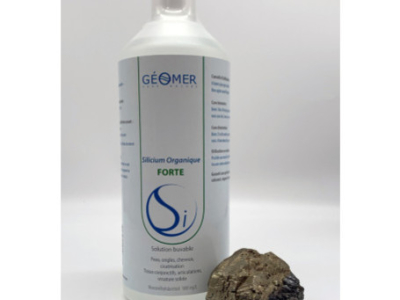
That's the whole point of monomethylsilanetriol (MMST), the form of organic silicon we've chosen at Laboratoire Géomer. And that's our difference: we're the only ones to guarantee 1,200 mg/L of stable silicon within a complete holistic range inspired by Traditional Chinese Medicine. Stable concentration, assimilable form: that's the condition for silicon to genuinely support the production of your own collagen, day after day. Another key advantage: silicon is a cofactor of mineral origin. It requires no animal product — unlike drinkable collagen. You give your skin what it needs to rebuild itself, in keeping with living things.
So, should you throw out your collagen?
Our position is honest, because the truth is more convincing than the slogan. Drinkable collagen isn't a scam: it can give a small boost. But it's the incomplete half of the equation. As long as your body doesn't have its cofactors — vitamin C and, above all, silicon — you're paying for bricks that no one assembles.
The smart strategy, then, isn't "drink more collagen," but giving your skin the means to make its own. That's exactly what highly concentrated MMST allows: instead of buying the finished product, you reactivate the factory. And a factory that's running is worth a thousand deliveries left in front of a closed door.
To understand in depth what organic MMST silicon is and why its concentration is decisive, read our complete guide: Organic MMST silicon: the complete guide.
Want to know if your skin is lacking silicon?
Get my personalized assessment →
Good to know. This article is for informational and wellness purposes. Géomer products are dietary supplements and cosmetics: they are not intended to diagnose, treat or prevent any disease, nor to replace medical advice. Consult a professional if in doubt.
Scientific sources:
Carlisle E.M. — Silicon: rôle dans la formation du tissu conjonctif (1970-1976).
Reffitt D.M. et al. — Orthosilicic acid stimulates collagen type 1 synthesis… in vitro, Bone, 2003;32(2):127-135.
Barel A. et al. — Effect of oral intake of choline-stabilized orthosilicic acid on skin, nails and hair…, Arch Dermatol Res, 2005;297:147-153.
Meta-analyses on collagen peptides and skin (hydration/elasticity), 2021-2023 — statistically significant but modest-magnitude effects.
Pharmacokinetic studies on the absorption of Pro-Hyp / Gly-Pro-Hyp peptides and the stimulation of fibroblasts.