Shopping Cart
There are no more items in your cart
The meridians of the human body: what are they and how to influence them?
Have you heard about meridians and wondered what they really are? These "energy pathways" described by Traditional Chinese Medicine (TCM) nearly 5,000 years ago connect every part of the body's surface to an organ. In this article, we explain simply what a meridian is, what the 12 main meridians are, what current research says — and how, in Laboratoire Géomer's energetic approach, the targeted application of a clay (the Terral) on a zone of the face fits into this logic of balance.
What is a meridian?
In Traditional Chinese Medicine, a meridian is an invisible channel through which Qi flows, most often translated as "vital energy." One can picture this network as a transport map: main lines running through the whole body and multiple branches irrigating each tissue. The Chinese call this whole system Jing Luo.
Three ideas are enough to understand the principle:
- Each meridian is linked to an organ whose name it carries (Liver meridian, Lung meridian, Kidney meridian…).
- Meridians are connected to one another and link the body's surface to its depths.
- According to TCM, stress, diet, lifestyle or emotions can disrupt this circulation, and it is this imbalance that one seeks to rebalance.
The face, acupuncture points, massage (Tui Na), Qi Gong: all these traditional approaches seek to act on the same network of meridians.
The 12 main meridians and their organs
TCM describes 12 main meridians, organized into six Yin/Yang pairs, each associated with an organ or a function. Here they are:
Lung — breathing, skin, defenses
Large Intestine — elimination, transit
Stomach — receiving and digesting food
Spleen-Pancreas — transformation, energy drawn from food
Heart — circulation, spirit (Shen)
Small Intestine — sorting and assimilation
Bladder — elimination of fluids
Kidney — ancestral energy, vitality, bones
Pericardium (Heart Protector) — protection of the Heart, circulation
Triple Burner — thermal and fluid regulation
Gallbladder — decision-making, bile distribution
Liver — harmonious circulation of Qi, emotional balance
To these 12 regular meridians are added eight "Extraordinary Vessels," considered reservoirs of energy. In TCM, each meridian is also linked to one of the five elements — a framework we detail on our page The Law of the 5 Elements.
The organ clock: when each meridian is most active
TCM teaches that energy does not circulate uniformly: it follows a 24-hour cycle called the organ clock (or meridian clock). Each meridian is said to have a two-hour peak of activity:
- 1–3 am: Liver · 3–5 am: Lung · 5–7 am: Large Intestine
- 7–9 am: Stomach · 9–11 am: Spleen · 11 am–1 pm: Heart
- 1–3 pm: Small Intestine · 3–5 pm: Bladder · 5–7 pm: Kidney
- 7–9 pm: Pericardium · 9–11 pm: Triple Burner · 11 pm–1 am: Gallbladder
This traditional, cyclical view is one of the reasons why TCM places such importance on the timing and regularity of care practices.
What does modern research say about meridians?
Let's be clear and honest: to date, science does not recognize the existence of a "meridian organ" in the classical anatomical sense, and the notion of Qi belongs to a traditional framework, not a measurable quantity. That said, several research teams are exploring interesting leads:
- The primo-vascular system (PVS): first described in 1962 by Korean researcher Bonghan Kim, then re-studied since the 2000s by the team at Seoul National University, this network of fine channels has been proposed as a possible anatomical basis for meridians. The work remains, however, debated and requires confirmation from other laboratories (PubMed review, 2016; Soh, 2009).
- Connective tissue and fascia: the landmark study by Langevin & Yandow found around 80% correspondence between the position of acupuncture points and connective tissue planes between muscles (The Anatomical Record, 2002). The authors themselves urge caution: correlation does not mean that fascia and meridians are identical.
Our position at Géomer is simple: we draw on millennia-old traditional knowledge whose foundations research is beginning to question, without ever overselling certainties. To learn more on this topic, read our article: Meridians and science.
The face: a miniature map of the meridians
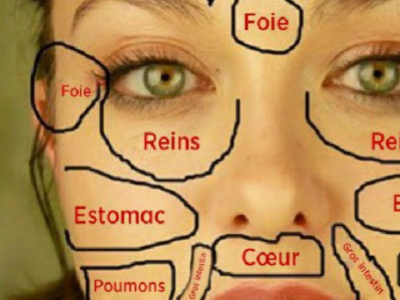
This is one of the most fascinating principles of TCM: each zone of the face is connected to a meridian, and therefore to an organ. The forehead, the eye contour, the wings of the nose, the cheeks, the chin: each of these regions "tells" something about our inner balance. This is known as face reading, which we explain in detail in Learn to read your facial skin.
This mapping is precisely what makes the face ideal for an energetic treatment: by working zone by zone, one follows the logic of the meridians.
Influencing your meridians daily: the Géomer Terrals approach
This is where our expertise comes in. The 5 Géomer Terrals are cosmetic clays, each applied to the facial zone corresponding to a meridian, according to the TCM reading grid. Clay is a recognized active ingredient for its cosmetic properties: it helps purify the skin, absorb excess sebum and impurities, and refine skin texture. The gesture of application and leaving it on, in turn, stimulates microcirculation and offers a genuine moment of relaxation.
In Géomer's energetic approach, this treatment aims to support the rebalancing of facial meridians: one works on the surface (the skin) while respecting the traditional mapping of the zones. The visible and felt result is cosmetic: a fresher, more radiant complexion, decongested and clear skin, and that very particular feeling of having treated oneself to a complete ritual.
How the 5-clay energetic treatment works
- Cleanse your skin with a gentle cleanser.
- Using a fine brush, apply each Terral to its zone, following the treatment diagram.
- Leave on for 5 to 7 minutes (a slight tingling may accompany this resting period).
- Rinse with lukewarm water, then continue with your usual skincare routine.
See the full step-by-step ritual →
To go even further
The Terrals energetic treatment pairs ideally with our Amplitudes (essential oil synergies) and takes into account seasonal influences, at the heart of the Géomer philosophy: address the root cause rather than the visible symptom.
In summary
According to TCM, the meridians of the human body form an energy network linking the body's surface to our organs. Modern research is exploring anatomical leads without yet fully validating them — but traditional knowledge offers a valuable map, particularly on the face. This is the map that Laboratoire Géomer brings within your reach with its Terrals: a simple energetic treatment to do at home, for more beautiful skin and a genuine moment of balance.
Get my personalized assessment →
Good to know. This article is for educational and wellness purposes. Géomer Terrals are cosmetic products: they care for your skin and are not intended to diagnose, treat or prevent any disease, nor to replace medical advice. In case of a health issue, consult a professional.
Take good care of your body: it is where your soul has chosen to live.
.png)
Alain Ledroit
CEO Laboratoire Géomer · Usui Reiki Master
creator of the ARK Quantique Process®
CEO Laboratoire Géomer · Usui Reiki Master
creator of the ARK Quantique Process®
Sources: Langevin HM, Yandow JA. Relationship of acupuncture points and meridians to connective tissue planes. The Anatomical Record, 2002 · Chronological Review on Scientific Findings of Bonghan System and Primo Vascular System. J Acupunct Meridian Stud, 2016 (PMID 27526157) · Soh KS. Bonghan circulatory system as an extension of acupuncture meridians. J Acupunct Meridian Stud, 2009 (PMID 20633480) · The meanings and prospects of primo vascular system from the viewpoint of historical context. (PMID 23762137)