Shopping Cart
There are no more items in your cart
Intermittent Fasting and Silicon: Renewing Your Cell
Seeking to live better often means seeking to give your body the right conditions to renew itself. Two practices keep coming up in this pursuit today: intermittent fasting and silicon intake. They don't act on the same front, and that's exactly what makes them complementary. One helps the body sort and clear things out, the other supports the architecture that holds it together. Here's what the science actually says, without shortcuts.
Autophagy: the great internal clean-up
Our cells have a natural maintenance system called autophagy — literally "self-eating." It's the process by which the cell breaks down and recycles its damaged components: misfolded proteins, worn-out organelles, accumulated waste. The discovery of autophagy's mechanisms earned Yoshinori Ohsumi the 2016 Nobel Prize in Medicine, which gives an idea of its importance to the biology of living organisms.
With age, and with constant food intake, this clean-up tends to slow down. Reactivating it is one of the most studied levers for supporting healthy cell function.
Intermittent fasting, the trigger for this clean-up
This is where fasting comes into play. When meals are spaced further apart, the cell senses an energy dip and switches into "maintenance" mode. The mechanism is now well described: fasting raises levels of NAD+, a cellular cofactor, which activates a family of enzymes called sirtuins (notably SIRT1). These sirtuins in turn trigger autophagy. This is known as the AMPK–SIRT1–autophagy axis, one of the most documented longevity pathways.
In practice, the most accessible protocol is 16:8: meals are concentrated within an 8-hour window, giving the body 16 hours of rest (for example, last meal at 7 PM, first meal the next day around 11 AM).
Who this isn't for. Intermittent fasting is a lifestyle practice, not a treatment. It is not recommended for pregnant or breastfeeding women, people with diabetes under treatment, anyone with a history of disordered eating, or children and teenagers. If in doubt, or if you have a medical condition, ask your doctor before starting.
Silicon: supporting the body's framework
If fasting handles recycling, silicon, for its part, contributes to structure. Silicon is a component of connective tissue: the body uses it in the formation of collagen and elastin, the fibers that give skin its elasticity and tissues their firmness. Yet silicon reserves in the richest tissues — skin, arteries — decline noticeably with age.
Several studies have examined silicon intake in bioavailable form. The reference study by Barel et al. (2005) observed, in women with photodamaged skin, the effect of oral orthosilicic acid intake on skin, nail, and hair parameters. Silicon is therefore not an "anti-aging" agent in the metabolic sense of the term: it acts on an entirely different level, that of tissue architecture. This is precisely why it pairs well with a cell renewal approach.
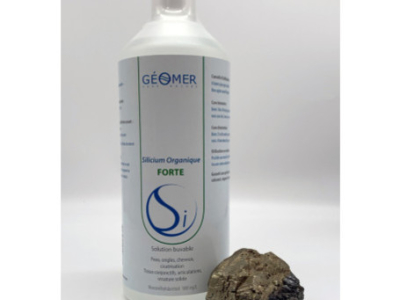
To go further on this molecule and its forms, our full guide on organic silicon covers everything you need to know. You can also discover our drinkable silicon.
Two complementary levers — not a magic formula
Should we conclude that fasting + silicon "multiply" their effects? Let's be honest: no study has tested this combination, and no one can claim a chemical synergy between the two. What is true, however, is that they act on two different, non-competing sides of the same goal.
Fasting does the big clean-up, silicon supplies the framework's building materials.
Clearing on one side, supporting the structure on the other. It's this ground-level logic — giving the body good conditions on several fronts at once — that makes their combined value, with each staying in its own lane.
How to work it into your routine simply
No need to overhaul everything. A gradual approach is enough: start by moving dinner earlier and breakfast later to gently work toward a comfortable fasting window, listening to your body; make sure, in parallel, to get a regular intake of silicon in bioavailable form; and support it all with good hydration, quality sleep, and a bit of movement. Consistency always beats intensity.
Frequently asked questions
.png) Alain Ledroit — CEO of Laboratoire Géomer, Usui Reiki Master, creator of the ARK Quantique Process®.
Alain Ledroit — CEO of Laboratoire Géomer, Usui Reiki Master, creator of the ARK Quantique Process®.
Scientific sources
• Reffitt D.M. et al., Bone, 2003 — orthosilicic acid stimulates type 1 collagen synthesis: pubmed.ncbi.nlm.nih.gov/12633784
• Barel A. et al., Arch Dermatol Res, 2005 — oral orthosilicic acid, skin/nails/hair: doi.org/10.1007/s00403-005-0584-6
• Morselli E. et al., Cell Death & Disease, 2010 — caloric restriction induces autophagy via SIRT1: pubmed.ncbi.nlm.nih.gov/21364612